As the 2021-2022 school year wraps up at Lake Stevens High School, students share what teachers were the most memorable throughout the years. These te...
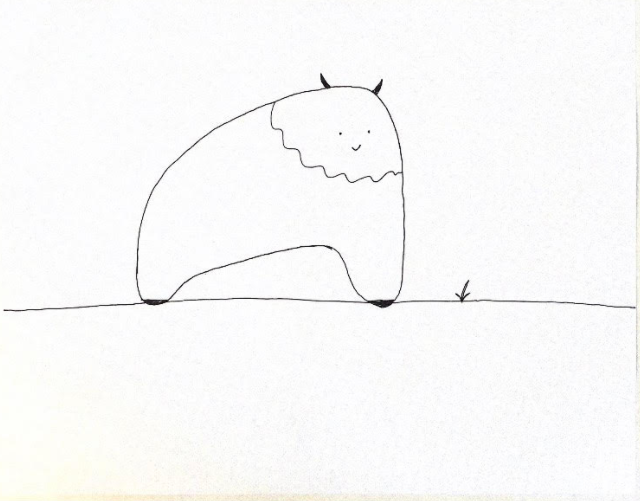
The black-and-white depiction of a blob-shaped buffalo standing alone in an empty field appears, at first glance, deceptively simple. Yet its minimalism is precisely what invites prolonged contemplation. The buffalo’s amorphous form—softened, rounded, and stripped of anatomical precision—immediately destabilizes our expectations. It hovers between representation and abstraction, teasing the viewer with a figure both familiar and uncanny.
This abstraction of shape can be read as a deliberate refusal of identity. The buffalo, historically a symbol of strength, endurance, and communal survival, has here been reduced to an indistinct silhouette. Its loss of definition suggests erasure: a fading of cultural memory, ecological presence, or personal wholeness. In this way, the artist challenges the viewer to consider what is left of a being when its boundaries are blurred beyond recognition.
The barren field reinforces this sense of existential isolation. No horizon line interrupts the expanse, and no environmental detail distracts from the buffalo’s solitude. The emptiness of the space mirrors the emptiness of context—without a herd, without a landscape, the buffalo exists in a vacuum. Such spatial isolation often symbolizes emotional desolation or cultural displacement.
The presence of a single blade of grass introduces a subtle but powerful counterpoint. Delicately vertical, nearly insignificant, it becomes a symbol of persistence. While everything else in the image suggests depletion or loss, this lone blade asserts the idea that life, however fragile, continues to emerge. Its thinness contrasts with the buffalo’s heavy mass, suggesting a dialogue between vulnerability and endurance.
In the work’s monochromatic palette, black and white coexist without gradation, emphasizing stark contrasts rather than nuanced transitions. This could be interpreted as a commentary on binary thinking—strength versus weakness, presence versus absence, identity versus anonymity. The buffalo, rendered in ambiguous form, refuses these binaries, instead occupying an ambiguous realm where opposites bleed into one another.
The blob shape also evokes a sense of melting or dissolving. It hints at impermanence, as though the creature is in the process of becoming something else—or perhaps disappearing entirely. In ecological terms, this can be read as a statement about species threatened by habitat loss or human intervention. In psychological terms, it speaks to the dissolution of the self under pressure.
The buffalo’s stance, undefined yet static, suggests resignation. Its posture implies neither motion nor resistance, but a contemplative stillness. This stillness invites the viewer to project their own emotions into the figure. Is it calm? Defeated? Meditative? The ambiguity transforms the buffalo into a mirror for the viewer’s own inner landscape.
The field, devoid of texture or detail, operates almost as a stage or void. It offers no narrative clues, pushing the viewer to confront the buffalo directly. The lack of environmental cues emphasizes the universality of the themes: isolation, identity loss, and quiet resilience are not bound to any one place or culture. Instead, the image becomes a distilled metaphor for the human condition.
The single blade of grass—symbol of hope or futility, depending on interpretation—anchors the entire composition. It can be read as a final stand against oblivion, a reminder that even in desolation, something persists. Alternatively, it might represent the overwhelming inadequacy of small gestures in the face of enormous, amorphous forces. The grass becomes both a promise and a lament.
Ultimately, the image’s hidden meaning lies in its invitation to contemplate fragility—of identity, memory, ecosystems, and emotional states. The blob-shaped buffalo functions as an emblem of beings caught between presence and disappearance. It stands in its field not as a triumphant figure but as a quiet question: What remains when form, community, and meaning begin to dissolve? The viewer is left to answer this question for themselves, completing the artwork through reflection.





Booker Katzer • Nov 17, 2025 at 11:02 am
The black-and-white depiction of a blob-shaped buffalo standing alone in an empty field appears, at first glance, deceptively simple. Yet its minimalism is precisely what invites prolonged contemplation. The buffalo’s amorphous form—softened, rounded, and stripped of anatomical precision—immediately destabilizes our expectations. It hovers between representation and abstraction, teasing the viewer with a figure both familiar and uncanny.
This abstraction of shape can be read as a deliberate refusal of identity. The buffalo, historically a symbol of strength, endurance, and communal survival, has here been reduced to an indistinct silhouette. Its loss of definition suggests erasure: a fading of cultural memory, ecological presence, or personal wholeness. In this way, the artist challenges the viewer to consider what is left of a being when its boundaries are blurred beyond recognition.
The barren field reinforces this sense of existential isolation. No horizon line interrupts the expanse, and no environmental detail distracts from the buffalo’s solitude. The emptiness of the space mirrors the emptiness of context—without a herd, without a landscape, the buffalo exists in a vacuum. Such spatial isolation often symbolizes emotional desolation or cultural displacement.
The presence of a single blade of grass introduces a subtle but powerful counterpoint. Delicately vertical, nearly insignificant, it becomes a symbol of persistence. While everything else in the image suggests depletion or loss, this lone blade asserts the idea that life, however fragile, continues to emerge. Its thinness contrasts with the buffalo’s heavy mass, suggesting a dialogue between vulnerability and endurance.
In the work’s monochromatic palette, black and white coexist without gradation, emphasizing stark contrasts rather than nuanced transitions. This could be interpreted as a commentary on binary thinking—strength versus weakness, presence versus absence, identity versus anonymity. The buffalo, rendered in ambiguous form, refuses these binaries, instead occupying an ambiguous realm where opposites bleed into one another.
The blob shape also evokes a sense of melting or dissolving. It hints at impermanence, as though the creature is in the process of becoming something else—or perhaps disappearing entirely. In ecological terms, this can be read as a statement about species threatened by habitat loss or human intervention. In psychological terms, it speaks to the dissolution of the self under pressure.
The buffalo’s stance, undefined yet static, suggests resignation. Its posture implies neither motion nor resistance, but a contemplative stillness. This stillness invites the viewer to project their own emotions into the figure. Is it calm? Defeated? Meditative? The ambiguity transforms the buffalo into a mirror for the viewer’s own inner landscape.
The field, devoid of texture or detail, operates almost as a stage or void. It offers no narrative clues, pushing the viewer to confront the buffalo directly. The lack of environmental cues emphasizes the universality of the themes: isolation, identity loss, and quiet resilience are not bound to any one place or culture. Instead, the image becomes a distilled metaphor for the human condition.
The single blade of grass—symbol of hope or futility, depending on interpretation—anchors the entire composition. It can be read as a final stand against oblivion, a reminder that even in desolation, something persists. Alternatively, it might represent the overwhelming inadequacy of small gestures in the face of enormous, amorphous forces. The grass becomes both a promise and a lament.
Ultimately, the image’s hidden meaning lies in its invitation to contemplate fragility—of identity, memory, ecosystems, and emotional states. The blob-shaped buffalo functions as an emblem of beings caught between presence and disappearance. It stands in its field not as a triumphant figure but as a quiet question: What remains when form, community, and meaning begin to dissolve? The viewer is left to answer this question for themselves, completing the artwork through reflection.
Hailey Cordell • Mar 29, 2021 at 3:58 pm
Such a cute drawing! The little buffalo looks so happy
Bren • Mar 29, 2021 at 1:23 pm
He’s friend shaped 🙂