

LSHS updated its cell phone policy this year to better combat phones distracting students in class. Upon entering class, students put their phones in a caddy or box with dividers at the beginning of each class.
With this new policy comes new opinions as students and staff alike adjust to the change. In order to gain a general understanding of the staff and students’ perspectives, surveys were sent out to the student body and all staff members to ask if they think the cell phone policy helps students or hinders students.
Most commonly, students picked the option right in the middle of “helps” and “hinders,” with other opinions swaying far on either side of the spectrum.
Many students who believe that the cell phone policy helps said that they have noticed their peers engaging more in school and connecting with each other. They also note that the increased attentiveness that no access to phones brings helps to rebuild attention spans.
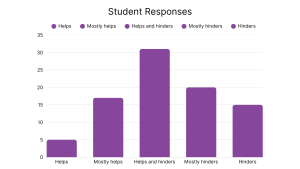
On the other hand, the students who think that the cell phone policy hinders students point out that phones are tools that will be with us for our entire lives, so we should learn how to use them responsibly rather than just having them be taken away.
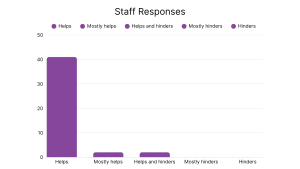
Contrastingly, a vast majority of staff have the same opinion: The cell phone policy firmly helps students.
Many staff members report increased social interaction, engagement and focus with the curriculum and academic performance from their students. Staff members also state that while off-task behavior does continue on Chromebooks, it is easier to manage than phones.
However, one staff response stood out. Joel Kesler made the point that while restricting phones may alleviate the problems they cause for education, it doesn’t emulate the real world— a point some students made and no other staff mentioned in the survey.
He explains that as a teacher, he can have his phone on him as long as he’s still doing his job, and it isn’t a problem until it becomes a problem. If that’s how the workplace handles employees having their phone on them, then the current phone policy isn’t preparing kids to function in an environment in which the employee does not control where their phone is.
The past policy allowed Kesler to turn taking a student’s phone away into an opportunity for students to learn how to make better choices and to have healthy boundaries around their phones. However, he believes this new policy takes away these opportunities.
“I have always maintained that stance of like, I want to teach my kids how to be responsible with their things, not just straight up take it away. It’s just missing an opportunity,” Kesler said.
He also brought up an issue that many other teachers disregarded: Chromebooks.
“Chromebooks now are a bigger issue than they have been in the past. And…that kind of tells me maybe we’re not actually getting to the root of the problem, and the root of the problem is healthy relationships around phones and computers…and how to use them appropriately versus inappropriately, and when to use them and how to just set boundaries,” Kesler said.
As technology becomes more and more integrated into our daily lives, it is more important to be able to use all kinds of technology responsibly, and the new cell phone policy doesn’t allow for the opportunity to start building the habits and self-control needed to thrive in life outside of high school.
While we all know what the expectations are here at LSHS, it’s not the same for every school, so let’s look at some statistics from across the country.
Seventy-seven percent of public schools across the U.S. have some sort of policy that prohibits phone use in classrooms
More elementary schools have policies prohibiting students from having phones during classes than secondary schools, 86 percent and 55 percent, respectively
Thirty-eight percent of schools with a policy prohibit phone use outside of class, such as during transition periods or during lunch
It seems that many policies countrywide have moved toward limiting phone use in one way or another.
While the new phone policy helps students to understand that their focus should be on work, if we give students an opportunity to learn how to be responsible as they transition into being adults in the workplace while there is still leniency, it will help them more in the long run.


